Other Doodles
Last updated: Sun 07 December 2025
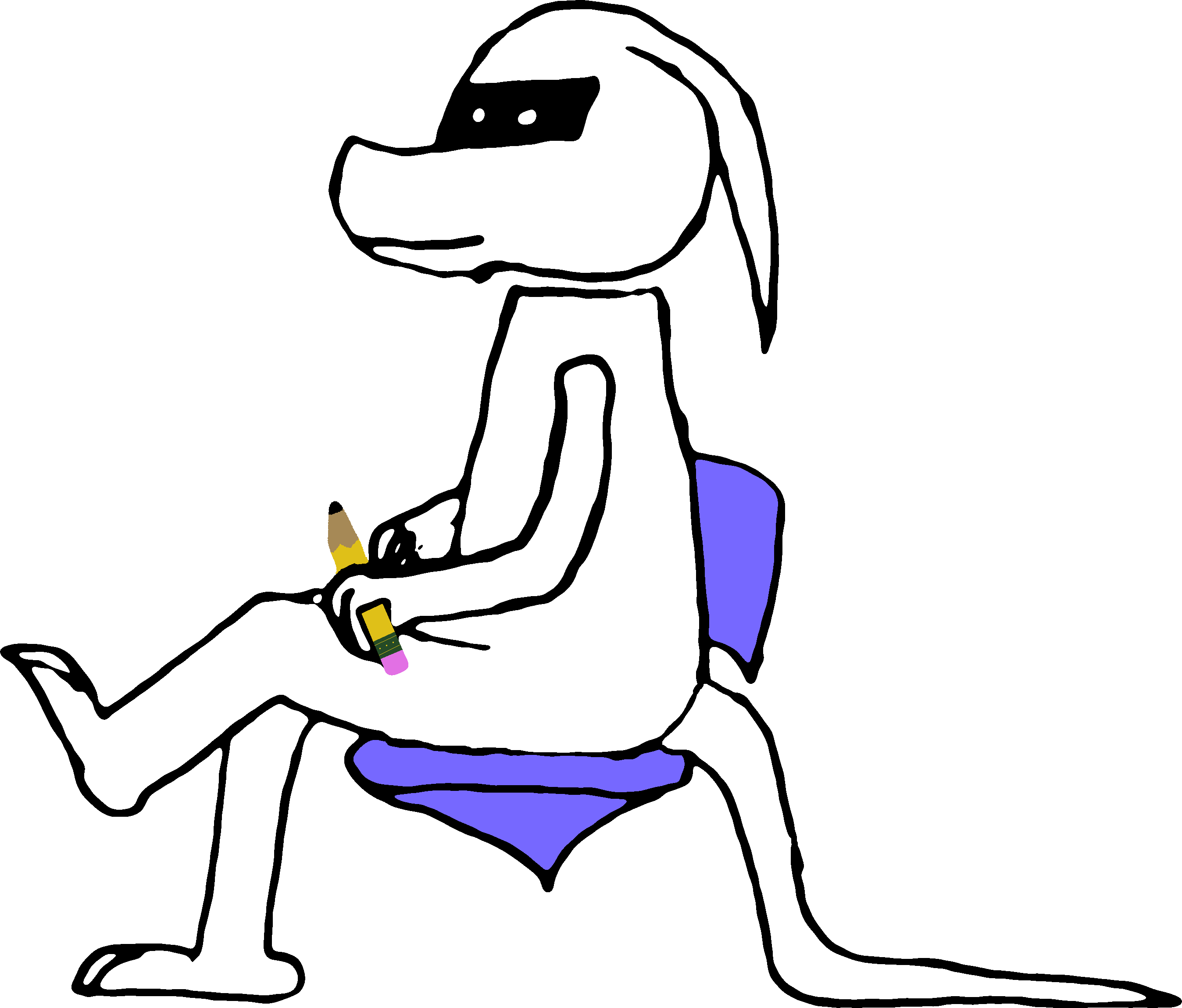
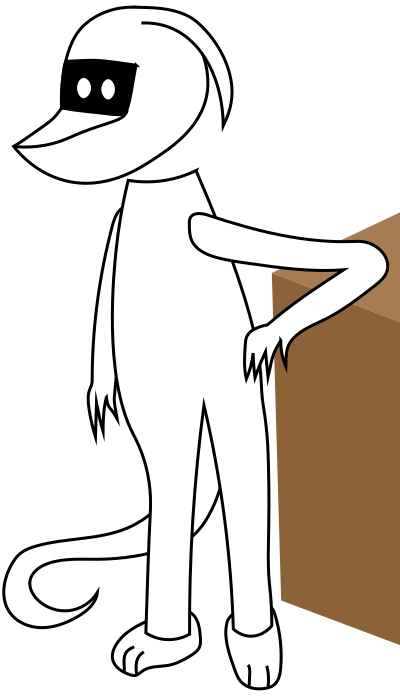
The graphic design class I took included a unit on page layout design, for print documents such as magazines and brochures. The project was to create a 4-page “zine” with text and images, for which I used some comic strips that I hadn’t released publicly yet. I finished writing the text for this at 1AM the night before it was due and ended up rambling for 6 pages about myself and the character I have created that represents me. I am ashamed to admit these were made in Adobe InDesign. Unfortunately neither I nor my teacher were allowed to install Scribus on the lab computers due to my college IT department’s lengthy software security review process.
Here’s the image on the last page, out on its own:
Project reflection questions
In your own words, what does a zine allow individual artists to do?
display their art along with their thoughts about it so they don’t have to keep explaining it to people that ask them about the art.
Why is being able to create a zine significant?
I beg to differ. You’re putting text and imagery together; that happens all the time even when you’re not doing it in InDesign. Every web page (such as the one you’re currently reading) does this with just HTML and CSS. Not significant.
What pieces of imagery (photos or artwork) will you use to accompany your written work?
I will be using the panels from two short comic strips that I have made. (I have a third, but it is not finished yet.)
How will your selected imagery benefit your text? (i.e. does your imagery help to explain a point? Does your imagery provide a visual example of your subject matter? Does your imagery simply fill space? If so, is it distracting or irrelevant?
The text is talking about and regarding the character present in the comic strips. The reader can just read the strips if they want to, but they can also read the text interspersed to learn more about the background of me making the comics.
In your own words, what does InDesign Do?
Lays out text in a set of boxes, and wraps it so it doesn’t overlap with images and shapes that you’ve also put on the page.
How is InDesign different from Illustrator and Photoshop?
It’s very limited (at least in terms of what it’s commonly used for) - you can only place images and shapes and text and make the text wrap around other things, versus Photoshop and Illustrator which actually let you edit the images.
What is layout design?
Mushing the elements (text, images, shapes) around until it looks appealing.
Why is it important to use a grid for layout design?
If it’s all misaligned it looks unprofessional and messy.
The final project was to edit together a short video from footage filmed by me, which was not difficult at all since I already have a youtube channel and have been doing that for about two years now. The only difference is that we were required to use Adobe Premeire Pro (rather than something like OpenShot; again sue to the college’s security audit process), but upgrading to a “professional” video editing layout and workflow was a welcome change as I hadn’t used anything other than iMovie previously.
If you just want to listen to the song:
Video project reflection questions
In your own words, what is time-based media?
Video or audio, or some other thing that has a sequence that can be played and runs at a constant rate (1 second per second).
What benefits do you think time-based media can provide for an artist?
It allows motion to be depicted easily - by depicting something moving…
Also, sound adds a lot of emotion to a piece and makes the interpretation of that more narrow.
What is the difference between linear and non-linear storytelling?
Nonlinear storytelling involves a lot of flashbacks and foreshadowing, while linear storytelling avoids that.
Do you intend to tell/create a video piece that is linear or non-linear in its progression? This question refers to the narrative/story you intend to create.
There’s hardly any story in a music video (it’s just the song), so I guess you could call it linear.
What type of audio will you work with? (song, interview, self-created soundscape, etc.?)
The song…
Will you video match your audio in its tempo (pace of music) or rhythm (placement of specific sounds)?
The cuts of the onscreen elements will match the song. Exactly. Every. Single. Note.
Will your video have the same theme (if applicable) as your audio? (i.e. similar subject matter as your audio)
Yes. It’s the music video for the song after all…
Write a brief summary of your concept for your one minute video piece:
The song will be made of samples of random objects that are not instruments, and the video will be the actual footage that produced the sounds, just cut to loop to coincide with the (pitch-shifted) notes.
How will you shoot/record your video? (what equipment will you use?)
Just my smartphone camera. I make all sorts of weird jigs with Legos to hold it up.
For the audio, I had to record 2 videos for some instruments, since the optimal distance for a good video was too far away (too quiet) for good audio.
In your own words, what does Adobe’s Premiere Pro do?
It’s a tool for cutting up and arranging chunks of footage, and arranging them with effects and stuff (filters/shaders, transformation of the frame, etc.) as well as manipulating the audio.
In video, what is an edit and what does it create/indicate in a time-based piece? (i.e. what effect does an edit have on a viewer’s interpretation of a shot or scene?)
An edit is any point where the raw video footage was manipulated, e.g. cut, faded, resized, recolored, looped, had text overlaid, etc. And the effect the edit has on the viewer depends on the specifics of the edit. There’s no good way to determine what “edits in general” will do. For example, zooming in away from the main focus to a small part of the scene may add either humor (if the zoom is pointing out something the host should have noticed, but didn’t), or add suspense and tension (if the zoom is highlighting something dangerous that the main character is going to interact with), or do nothing at all (such as zooming in on a particular object to set up a crossfade into the next scene).
What information is contained in a title and credit sequence?
The title sequence can introduce the official name of the content, but it can also just serve as a general introduction. The credits list people that helped make the content, such as editors, writers, sponsors, etc.
What is the purpose of a title and credit sequence?
↑
Also the length of a credits roll is a rough indication of how much work it was to create the thing.
